Monday, October 29, 2012

Anglo-Saxon Riddle


Cresting waves, the sea-foam sprays,
So long since on that plane I played,
Among the fish, I lay my head,
Broken and battered, nearly dead,
My bones, they crackle, creak and groan,
As I’m crushed here all alone,
My innards splayed across the sand,
Baubles and beauties shiny and grand,
The light is fading, my time has come,
My appendages covered in scum,
Resting now, drawn my final breath,
Given in to welcomed death,

Anglo-Saxon Boast: Why I am Awesome


Gather all thee great in glory,
To hear my life-tale in great detail.
For I am Carson! Borne of the south,
In a land beneath the briny blue,
Riddled with sea-gates along the great river.
Son of George, proud carpenter and educator,
And Karen, one tasked with recording of numbers.
Brother of Conner, mead-giver and student,
And brother of Cooper, a boy with no brain.
The Earth shudders at the mention of my name!
Reader of books, conqueror of the oceans,
Dreamer of the day, explorer of the night,
My prowess in knowledge knows no bounds,
Tests of quick-wit and wisdom I have won.
In the water, I lead my team
To tournaments and championships beyond,
Though small in number we boldly fight
To earn our place among the winners.
Four years have we competed in state competitions.
Perhaps this year we’ll show might above all.


If the video doesn't load try this link:

Grendel as a Narrator


In John Gardner’s version of the story of Beowulf, he decides to shift the narration to a different viewpoint. Instead of starting at the arrival of the Geats and the story being told with Beowulf as its center, Gardner decides to use the monster Grendel. Beginning in Grendel’s childhood, Gardner creates a story of self discovery and conflicting philosophies that shows the other side of story. I think that Gardner chose Grendel to narrate his book because of the how different it would be from the traditional story. Instead of glory and honor, Gardner’s tale shows a darker side to society that Grendel discovers as he tries to find his own purpose. This allows Gardner to explore complex social, political, and philosophical concepts that wouldn’t be possible through Beowulf’s point of view. Grendel’s status as a monster is also a great opportunity for Gardner to maintain a sense of objectivity. Grendel isn’t human; therefore he is free from human biases. Gardner is able to narrate the story with Grendel as an observer describing the oddities and values he sees in human society. This allows the book Grendel to be an excellent insight into the intrinsic values, morals, and philosophies of human society and how they conflict with humanity’s race to rise above barbarity.

Grendel as a Parody


In the book Grendel, John Gardner attempts to parody the traditional epic story of Beowulf. In essence, a parody is an imitation of a writing that uses an exaggerated style to produce a humorous effect. Gardner is successfully able to produce this effect through the use of a similar writing style and a contradictory stance on the story. Gardner tells the story from a different point of view, through the eyes of Grendel the monster rather than Beowulf. Instead of telling a story of glory, honor, and battles, Grendel shows the sadistic side of humanity and how their society was founded on the ideas of barbarians. Not only does Gardner parody the plot, he also copies the Anglo-Saxon writing style. In later chapters, Grendel is able to mold words into verse and poetry in order to mock the humans he so hates. In this way Gardner mocks the Anglo-Saxon love of figurative language. Instead of the hero that defeats the monster through his god-given strength, Beowulf is portrayed as an almost evil man who revels in the pain of his enemies. He tortures Grendel as he kills him, publicly humiliating him before brutally tearing his arm off. Gardner twists the story from the classic “man vs monster” into a gruesome display of sadism exerted on a character that the reader has become attached to. Gardner’s development of Grendel’s character makes the reader think of him as more than a monster and casts a shadow over Beowulf, making him seem like the antagonist of the story. Through all these methods Gardner has produced what can be said as an excellent parody of Beowulf.

Techniques of Anglo-Saxon Literature


In Anglo-Saxon literature there are many techniques of language that are used to enrich and augment the reading of the pieces. Traditional Anglo-Saxon pieces were spread orally so the language focuses on aesthetically pleasing words. Many pieces share similar themes and images that augment the experience of reading. Two particular poems “The Seafarer” and “The Wanderer” have many characteristics in common with each other and the epic Beowulf.
                In “The Seafarer”, the narrator is a man describing his state of sacrifice and devotion to modesty. It is an elegy of a sailor who constantly submits himself to the harsh, cold sea in order to live the life of sacrifice needed to reach the afterlife he believes in. There are many kennings found throughout the piece such “sea-fowl” and “death-noise”. It also follows the same use of alliteration in lines such as “No kinsman could offer comfort there” and “So summer’s sentinel, the cuckoo, sings.” Besides literary techniques, this poem also has a few points in common with the theme of Beowulf. “The Seafarer” preaches a life of sacrifice to save one’s soul while in Beowulf a similar pattern of sacrifice occurs, not for his soul, but for his people. Just as the seafarer thrusts himself back out to sea to separate himself from enjoyment, celebration, and indulgence, Beowulf throws himself into battles to gain glory and protect those he cares for. Both men seek a life of sacrifice to support their beliefs.
                Another poem “The Wanderer” is written many centuries later by an English writer in the traditional form of an Anglo-Saxon poem. It tells the tale of a man who has lost his home and lord. Without his leader he is in a state of self-exile, fooling himself into thinking that people will not accept him. Uses of kennings are also apparent here as in “frost-cold” and “sea-birds”. Alliteration is a recurring pattern among lines through examples such as “his heart and follows the frost-cold foam”, “to whom my heart could hurry, hot”, and “forced to flee the darkness that fell.” In terms of theme, “The Wanderer” has less in common with Beowulf than “The Seafarer” but still shares a few key points. The narrator of “The Wanderer” is the last survivor of his community. In Anglo-Saxon times the community was everything to a man. Loyalty to one’s lord and being with others was valued above all and once lost left a heavy toll on one’s heart. The lord and friends of the wanderer were murdered before his very eyes, much in the same way that all men who rested in the mead-hall of King Hrothgar were murdered by Grendel. Just as the collapse of the community fractured the heart of the wanderer, the murder of Hrothgar’s men before his eyes paid a heavy toll on his mind. 

What is Grendel's attitude toward language and how does it change through the story?


In Gardner’s adaptation of Beowulf, the character Grendel’s use of vocabulary evolves over the course of the story. In the beginning Grendel is still in what is considered his childhood where he doesn’t completely understand the concept of language. He doesn’t remember when exactly he learned how to speak, but he understands that it is a part that makes him different from the instinctual animals that he hunts. He notices that his mother has long since lost the gift of speaking.  Without anyone to talk to, Grendel becomes very lonely and often contemplates his purpose in the world. In his first encounter with humans, he discovers that he is not the only one with the ability to speak, and tries to communicate with them. His guttural roars are misinterpreted by the humans, even though they speak the same language, and he is attacked. Grendel learns through this experience that language is a form of communication, but also that creatures with the ability to use it have higher intelligence. After meeting the dragon and observing the humans for twelve years, Grendel becomes proficient in the use of his linguistic skills and continually flaunts them when he can. He tries to understand the ways of humans and why they exist in order to provide a meaning for his own existence. He mocks the tales of heroes and their epics to play tricks on Unferth’s mind and even recites lines of poetry he has learned from the Shaper. In the end Grendel is forced by Beowulf to sing of walls in a final act of humiliation. At this point, Grendel feels that language is a device that men use to fill each other with fanciful ideas and to bend the truth. He sees the inner barbarity of humanity and is disgusted by their ability to sugar-coat gruesome battles with overtures of glory and fame. From babe to beast, Grendel realizes that language can be beautiful, but more often a messenger of lies and deceit for the debilitation of others.

Beowulf: the Archetypal Dragonslayer


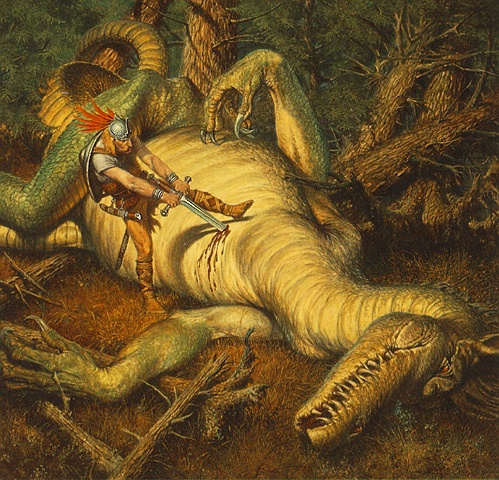
The hero Beowulf is considered as representative of the archetype of the dragon slayer. The characteristic of this archetype is that the hero risks their life to save a community. In modern times there are people who exist who also represent this same archetype. They may not be blood-covered warriors who slay monsters with their bare hands, but they risk their lives in much the same way every day to save the innocent. They are the modern day Beowulfs; the ones who boldly serve for the people. The soldiers of the United States of America are our sword and shield to protect us in times of need.
                These two heroes share many of the same characteristics. For one, our troops have been trained to use weapons but they are also proficient in hand-to-hand combat. Beowulf also does this although he likes using his hands just because they are stronger. Another characteristic they show is bravery. Beowulf boldly grapples with monsters and beasts that represent evil and opposition in his time. In our times, it takes courage to go out on to the battlefield where the difference between life and death could be one bullet. Also, Beowulf and soldiers don’t defend the citizens for money, but glory. Soldiers today do receive a little money for their services but that’s because they need to make a living as well. The final archetypal characteristic they share is their loyalty. Beowulf is proud of his Geat lineage just as US soldiers are proud to be Americans